Introduction
This article aims to shed light in mapping global LENR Funding. Low-Energy Nuclear Reactions (LENR)—sometimes referred to as “cold fusion” or LANR; have captured the inquisitive minds of scientists, investors, and clean-energy advocates for decades. While early controversies casted doubt on the field, total investments now exceed $1.1 billion which indicates serious interest. This seems like a lot of money that goes towards LENR’s potential to provide a clean and abundant energy source.
However, it is a small amount considering the research into many other scientific and engineering endeavors. To add more challenge to the Pandora’s box of LENR/LANR, a lot of funding is in black boxes of the private and military sectors of financial markets.
In this article, we attempt to map out the major players, funding flows, and breakthrough research areas shaping the LENR landscape today.
1. Government & Institutional Support
ARPA-E
One of the most significant markers of LENR’s newfound credibility comes from the U.S. Department of Energy’s ARPA-E program. In 2023, ARPA-E allocated $10 million across eight LENR-related research projects. Grant recipients include well-known institutions such as MIT, Stanford University, and Lawrence Berkeley National Laboratory—each focused on investigating anomalies in metal-hydride systems.
- MIT: $2M experimental platform for nuclear anomalies
- Stanford University: $1.5M to explore LENR-active nanoparticles
- Texas Tech University: $1.15M for advanced materials research
NASA
Another major U.S. entity is NASA, specifically at the NASA Glenn Research Center, which has conducted internal Lattice Confinement Fusion (LENR-like) research for nearly a decade. While the exact budget remains undisclosed, NASA’s patent filings and technical memoranda highlight a consistent R&D push aimed at verifying and scaling LENR phenomena.
- NASA Patent: Lattice Confinement Fusion Patent (US20230140886A1)
- NASA Technical Report: Lattice Confinement Fusion in Deuterated Metals
European Union (Horizon 2020)
Under the CleanHME initiative, the European Union funded the Horizon 2020 project, investigating hydrogen-metal energy systems. While exact figures remain undisclosed, the EU’s commitment to LENR underscores its growing global appeal.
- CleanHME LENR Project: EU Horizon 2020 Funding
Mapping Global LENR Funding in Japan, China, India, and Russia
Japan
Japan has been a strong advocate for LENR research, investing through government agencies and corporate-backed research. The New Energy and Industrial Technology Development Organization (NEDO) has sponsored LENR projects, particularly the nano-metal hydrogen energy (MHE) project. Companies like Mitsubishi Heavy Industries, Toyota, and Nissan have also invested in LENR.
- Historic funding: The New Hydrogen Energy (NHE) Program allocated approximately $20 million in the 1990s to explore LENR.
- Japan CF Research Society: Established in 1999, promoting further LENR research and collaboration. (ICCF Proceedings on Japanese LENR Research)
- Mitsubishi Heavy Industries LENR Patents: Patent Document
Russia
Russia has been investigating LENR since the 1990s, particularly through the Joint Institute for Nuclear Research (JINR) in Dubna and military-affiliated research institutions. The Defense Intelligence Agency (DIA) has identified Russia as an active player in LENR development. (DIA LENR Report)
China
China has significantly expanded its LENR research through its Academy of Sciences and national laboratories. Recent reports indicate that the Chinese government is investing in LENR as part of its broader clean energy initiative. (National Natural Science Foundation)
India
India has been conducting LENR research through its Bhabha Atomic Research Centre (BARC) and Indian Institute of Science.
- Government involvement: Funding from the Department of Atomic Energy (DAE). (BARC LENR Research)
Many of the financial data for countries outside NATO are difficult to find. If anyone has more information, please feel free to contact the author.
2. Private & Venture Capital Investments
Industrial Heat, LLC
A high-profile name in the LENR world, Industrial Heat, signed a $11.5 million licensing agreement in 2012 with Andrea Rossi’s “E-Cat” technology. Though Rossi’s claims remain controversial as he has yet to deliver on several products. However, this investment signaled an appetite for high-risk, high-reward LENR ventures.
Brillouin Energy Corporation
Collaborating with SRI International, Brillouin Energy secured approximately $60 million in 2015 to develop a hydrogen-metal-based LENR reactor. The company emphasized progress in controlling and replicating excess heat phenomena.
Google’s Cold Fusion Research
In 2019, Google funded a $10 million project in collaboration with MIT and Berkeley Lab to reevaluate cold fusion experiments. While no clear breakthrough was claimed to the public, the study emphasized the need for higher-quality experimental designs.
3. Non-Profit & Philanthropic Contributions
Sidney Kimmel & SKINR
In 2012, philanthropist Sidney Kimmel provided $5.5 million to establish the Sidney Kimmel Institute for Nuclear Renaissance (SKINR) at the University of Missouri. The financial data was difficult to trace so if anyone as further information please contact the author.
Anthropocene Institute
Offering $25K–$100K grants, the Anthropocene Institute helps smaller non-profits and universities venture into LENR research.
LENRIA & ISCMNS
Two research organizations, LENRIA and ISCMNS, serve as global hubs for LENR collaboration, conferences, and open publications.
4. Why LENR Matters
- Potential for Clean Energy: LENR could provide high-density energy with minimal radioactive waste as well as remediate current waste.
- Scientific Controversy & Progress: LENR research has evolved with more rigorous methodologies and transparent data sharing. Expanding new frontiers of understanding in many facets of science.
- Global Collaboration: Funding spans Europe, North America, and Asia, with a diverse community contributing to the scientific and technological foundation of Fusion Energy.
5. Graphic Visualizations for Mapping Global LENR Funding

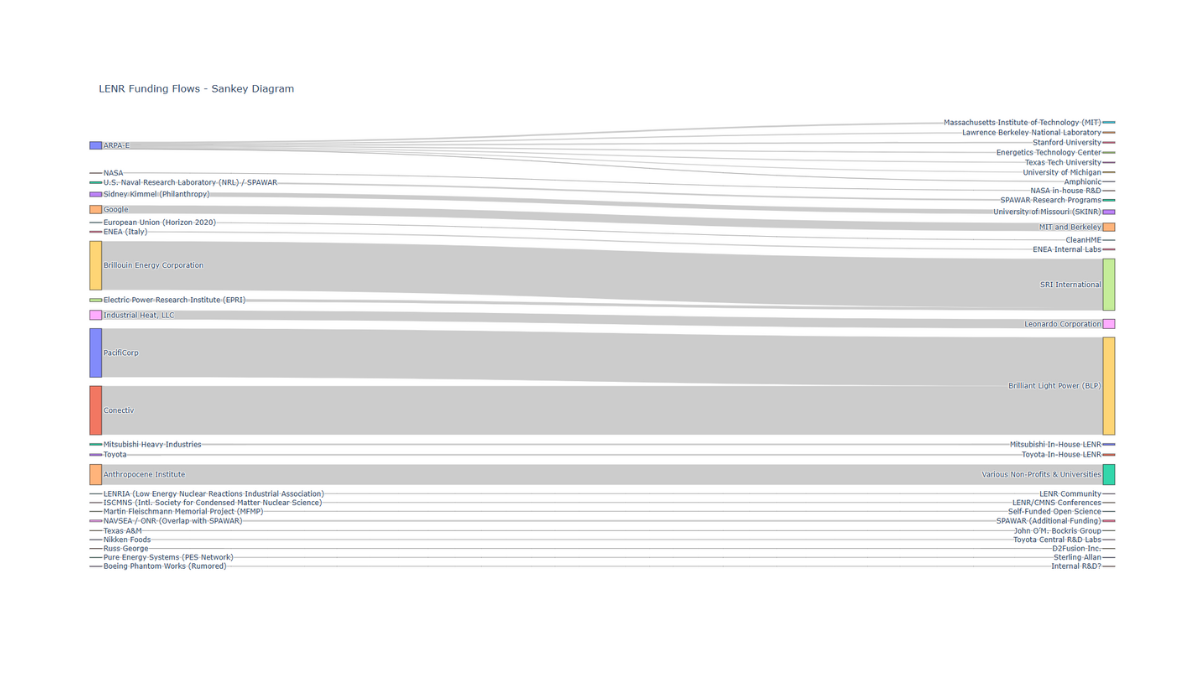

Here is the .csv Data Set for mapping global LENR funding.
Conclusion
The surge of funding from ARPA-E, NASA, Google, Industrial Heat, and others marks a turning point for LENR research. With over $1.1 billion in cumulative investments, the world is witnessing a serious push to validate and scale LENR technologies.
About Conscious.Energy
At Conscious.Energy, we explore cutting-edge sustainable technologies, from LENR research to decentralized energy systems. Stay tuned for more updates on global LENR breakthroughs and their implications for clean energy.
Disclaimer: Funding data represents approximate and/or disclosed values from publicly available sources, including government announcements, press releases, and institutional reports.

Great initiative.