


Author: Diadon Acs
Date: 13/9/2024
Open-Science Publication Conscious.Energy
Abstract:
The Energy Freedom Paradox (EFP) posits a complex interplay between energy availability, socio-economic development, individual perception, and societal well-being. This paper presents a mathematical formulation of the EFP, integrating key concepts from physics, economics, and information theory. Our model elucidates the intricate dynamics of energy systems and their socio-economic implications, offering a nuanced perspective on energy policy and sustainable development.
Keywords:
Energy Freedom Paradox, socio-economic development, individual perception, well-being, Jevons Paradox, Easterlin Paradox, information theory, mathematical modeling.
1. Introduction
Background: Energy is a fundamental driver of socio-economic development. The notion of energy freedom—defined as the perceived availability and accessibility of energy—introduces a complex dynamic between energy systems and human societies. The Energy Freedom Paradox hypothesizes that while increased energy availability can promote socio-economic progress and enhance individual perceptions of freedom, it also poses challenges related to environmental impact and equitable distribution.
Objectives: This paper aims to develop a comprehensive mathematical model that captures these dynamics, integrating insights from physics, economics, and information theory.
Scope: We explore the integration of concepts from thermodynamics, economics, sociology, and information theory into our model, drawing on the Jevons Paradox and the Easterlin Paradox to provide a robust theoretical framework.
2. Literature Review
Energy and Socio-Economic Development: Previous studies have demonstrated the critical role of energy in driving economic growth and improving quality of life (Cleveland & Ruth, 1998; Daly, 1973). However, increased energy consumption can lead to environmental degradation and resource depletion, complicating the relationship (Cosme et al., 2017; Denison, 1962).
The Jevons Paradox: The Jevons Paradox highlights the counterintuitive outcome where improvements in energy efficiency lead to increased overall energy consumption due to reduced costs and increased demand (Saunders, 1992). This underscores the importance of considering rebound effects in energy policy and efficiency measures (De Borger et al., 2016).
The Easterlin Paradox: The Easterlin Paradox challenges the assumption that higher income levels correlate with greater happiness and well-being. It suggests that relative income and social comparisons significantly influence individual satisfaction and societal well-being (Easterlin, 1974; Graham, 2011).
Information Theory: Information theory provides a framework for understanding the interchangeability of energy, information, and money. The concept that these entities can be mathematically represented as equivalent allows for a unified approach to analyzing their impact on socio-economic systems (Shannon, 1948; von Neumann, 1949; Brillouin, 1956).
3. Theoretical Framework
Key Concepts: The theoretical framework of the EFP integrates concepts from multiple disciplines:
– Relative Field Capacity


– Velocity of Exchange


– Resistance


– Information Content


Hypotheses: The primary hypotheses derived from the EFP are:
- There is a non-linear relationship between energy availability and socio-economic development.
- Energy efficiency improvements may lead to rebound effects, increasing overall energy consumption (Jevons Paradox).
- Increased energy availability yields diminishing returns on well-being (Easterlin Paradox).
- Energy, information, and money are interchangeable within socio-economic systems.
4. Mathematical Formulation
Variables and Parameters:
– Technological Advancement


– Energy Availability


Where:
–


–


– Socio-Economic Development :


Where:
–


–


–


–

–


–


–


– Environmental Impact


Where:
–


– Health and Well-being


Where:
–


–


– Perception


Where:
–


–


–


– Information Content


Where:
–


–

Combined Formula:
By substituting


Substituting


Explanation:
– The term


– The term


– The logarithmic function


– The rebound effect

5. Model Analysis
Empirical Data:

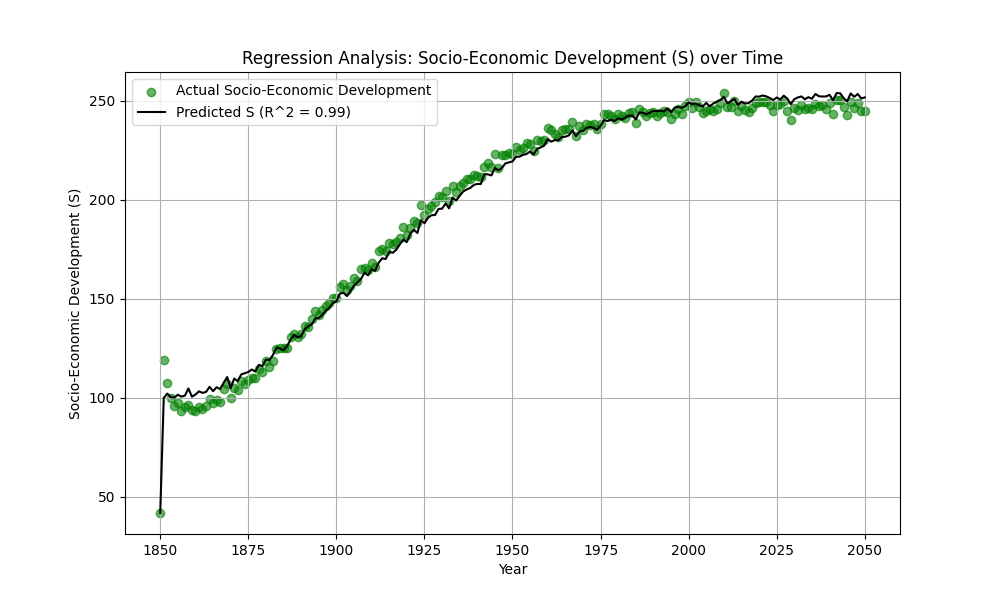


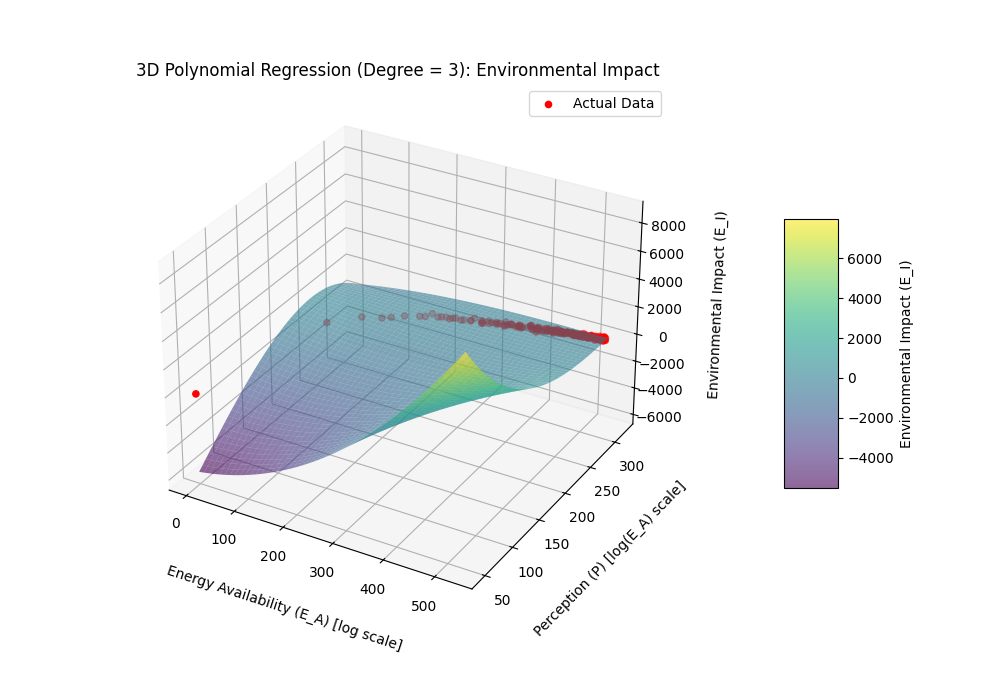
Data sources include:
– Energy Consumption: International Energy Agency


– Socio-Economic Indicators: World Bank, United Nations Development Programme


– Well-being Metrics: World Happiness Report, OECD Better Life Index.
– Information Content: Internet World Stats, ITU data on global information infrastructure.
Parameter Estimation:
– Regression Analysis: Used to estimate proportionality constants (


– Sensitivity Testing: Examines how variations in parameters affect the model’s outcomes.
Simulation Results:
Simulations explore scenarios such as:
– Increased Energy Efficiency: Assessing rebound effects due to technological advancements.
– Resource Distribution Changes: Evaluating the impact of equitable vs. unequal distribution


– Technological Advancement: Modeling the effects of different rates of technological progress

– Information Content Growth: Analyzing how increasing


Sensitivity Analysis:
– Key Parameters: Focus on


– Findings: Identifies thresholds where small changes in parameters lead to significant shifts in

6. Discussion
Interpretation of Results:
– Trade-offs: Highlighting the balance between energy availability and environmental impact.
– Rebound Effects: Demonstrating how energy efficiency can inadvertently increase consumption.
– Diminishing Returns: Confirming that beyond a certain point, additional energy availability contributes less to well-being.
Comparison with Existing Models:

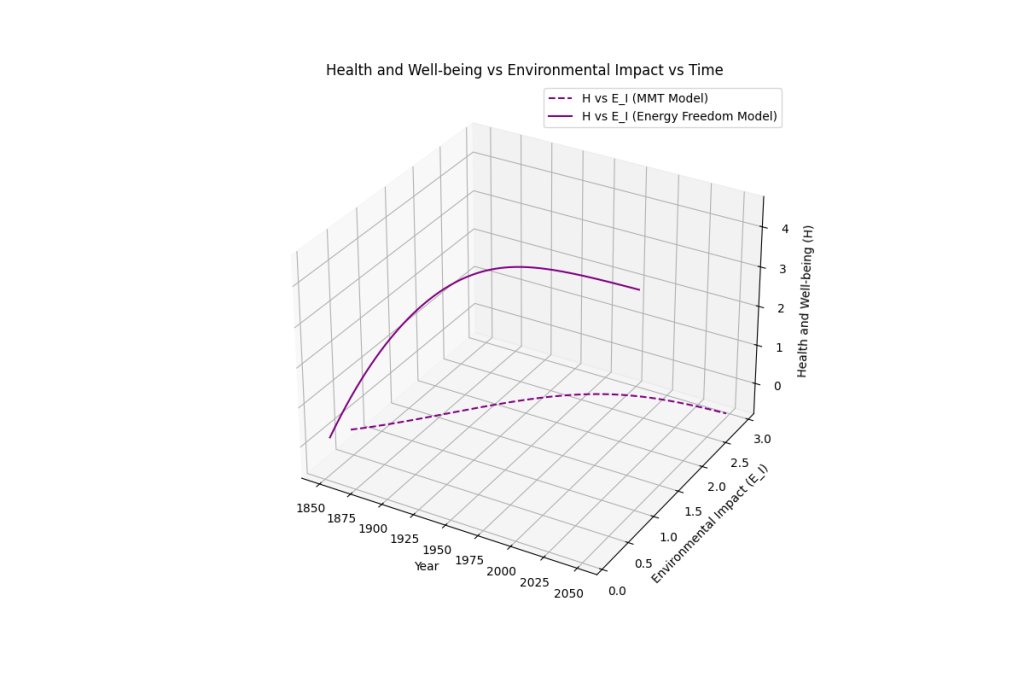


– Conventional Economic Models: Our model incorporates non-linear dynamics and rebound effects often overlooked.
– Sustainability Frameworks: Enhances existing models by integrating information theory and perception variables.
Policy Implications:
– Energy Efficiency: Policies should account for rebound effects by coupling efficiency improvements with consumption limits.
– Equitable Distribution: Emphasizes the importance of fair resource distribution to enhance socio-economic development.
– Information Accessibility: Suggests that increasing information content can positively impact perception and well-being.
7. Conclusion
Summary:
This paper presents a mathematical model of the Energy Freedom Paradox, integrating concepts from physics, economics, and information theory. The model demonstrates the complex interplay between energy availability, socio-economic development, environmental impact, and individual perception.
Future Research:
– Refinement of Rebound Effect Function


– Integration of Cultural Factors: Explore how cultural affinities influence perception and well-being.
– Policy Simulation: Use the model to simulate the effects of specific energy policies on societal outcomes.
Citation:
– Brillouin, L. (1956). *Science and Information Theory*. Academic Press.
– Cleveland, C. J., & Ruth, M. (1998). Indicators of Dematerialization and the Materials Intensity of Use. *Journal of Industrial Ecology*, 2(3), 15–50.
– Cosme, I., Santos, R., & O’Neill, D. W. (2017). Assessing the Degrowth Discourse: A Review and Analysis of Academic Degrowth Policy Proposals. *Journal of Cleaner Production*, 149, 321–334.
– Daly, H. E. (1973). *Toward a Steady-State Economy*. W.H. Freeman.
– De Borger, B., Mulalic, I., & Rouwendal, J. (2016). Measuring the Rebound Effect with Micro Data. *Journal of Environmental Economics and Management*, 79, 1–17.
– Denison, E. F. (1962). *Sources of Economic Growth in the United States and the Alternatives Before Us*. Committee for Economic Development.
– Easterlin, R. A. (1974). Does Economic Growth Improve the Human Lot? Some Empirical Evidence. In *Nations and Households in Economic Growth* (pp. 89–125). Academic Press.
– Graham, C. (2011). *The Pursuit of Happiness: An Economy of Well-Being*. Brookings Institution Press.
– Shannon, C. E. (1948). A Mathematical Theory of Communication. *Bell System Technical Journal*, 27(3), 379–423.
– von Neumann, J. (1949). *Theory of Self-Reproducing Automata*. University of Illinois Press.
Reference Resource Links:
Energy Freedom Paradox (2023) – An essay on unifying socio-economic system dynamics
Brillouin, L. (1956). Science and Information Theory. Academic Press.
- Internet Archive – Full text available for borrowing(Internet Archive).
- Open Library – 2nd Edition, 1962(Open Library).
Cleveland, C. J., & Ruth, M. (1998). Indicators of Dematerialization. Journal of Industrial Ecology.
- Wiley Online Library – Journal of Industrial Ecology.
Cosme, I., Santos, R., & O’Neill, D. W. (2017). Assessing Degrowth Discourse. Journal of Cleaner Production.
- ScienceDirect – Article available on ScienceDirect.
Daly, H. E. (1973). Toward a Steady-State Economy. W.H. Freeman.
- Google Books – Information available via Google Books.
Easterlin, R. A. (1974). Does Economic Growth Improve the Human Lot?. Academic Press.
Shannon, C. E. (1948). A Mathematical Theory of Communication. Bell System Technical Journal.
Bell System Technical Journal PDF – Full PDF of the original article.